Concealed Identity and Secrets
The Tenant of Wildfell HallConcealed Identity and Secrets are not incidental mysteries in the novel but practical instruments of survival. Helen Graham conceals the place where she lives, controls what Gilbert Markham can learn, and ultimately withholds her refuge from relatives so they can truthfully deny knowing it. The same guardedness that protects her also invites suspicion, making secrecy a defense against danger and a condition that other people misread.
A false name and a guarded picture
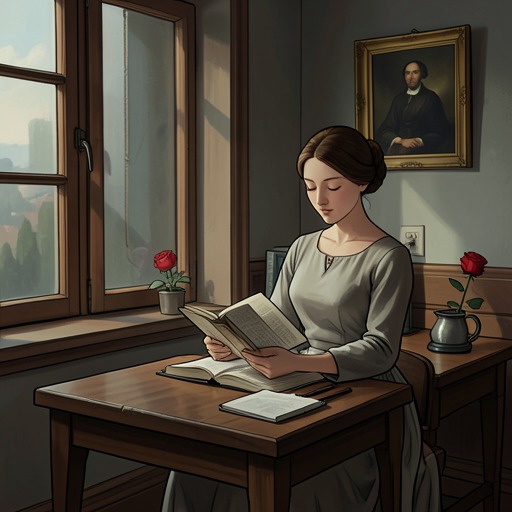
While painting a landscape of her present home, Helen gives the canvas a false title: Fernley Manor, Cumberland, rather than Wildfell Hall. When Gilbert notices the discrepancy, she explains that she has acquaintances from whom she wants her abode concealed. They might recognize her artistic style despite the false initials on the picture, so she has also changed the place-name to send anyone trying to trace her in the wrong direction. The disguise is deliberate and layered: neither the signature nor the landscape’s title is meant to lead reliably back to her.
The painting makes concealment visible without fully disclosing its cause. Helen is willing to explain the precautions, but not to identify the people she fears may find her or to tell Gilbert why they would seek her. Her frankness is therefore carefully bounded: she tells him enough to make the false name intelligible, while keeping the danger and her past outside his grasp. The landscape is at once a work she has made and a possible means by which she could be found, so she alters its identifying marks before it can betray her.
That boundary is enforced when Gilbert discovers a second portrait behind another picture, its face turned to the wall. He recognizes it as a portrait of a handsome young man, but Helen responds that looking at it was an impertinence and refuses to answer questions about it. Her flushed cheek and kindling eye show that the intrusion has seriously annoyed her. The covered portrait is not simply an unanswered puzzle: the scene establishes that Helen’s private images and the story behind them are not Gilbert’s to uncover at will.
Secrecy observed and turned into rumor
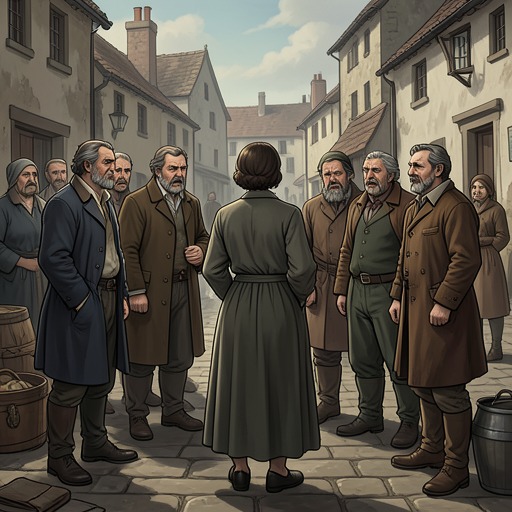
The unexplained precautions acquire a public afterlife. Rose Markham recalls both the false name on the painting and the visitor whose arrival caused Helen to leave the room abruptly. Arthur Graham had described that visitor as his mother’s friend, but Rose says that the family did not catch sight of him. These fragments become part of the talk Rose has heard at the Wilsons’ and the vicarage; combined with the judgment that a proper woman would not live alone, they encourage suspicion rather than understanding.
The episode shows how a protective secret can be transformed by observers into evidence against the person keeping it. Helen’s wish to conceal her address is recast as mystery, while her refusal to disclose a visitor becomes another suggestive omission. Rose has details, but not the circumstances that would explain them. The contrast between what Helen actually says—that she fears being traced—and what the community infers exposes the vulnerability of a woman whose privacy is interpreted through rumor and expectations about respectable conduct.
The past withheld and the limits of disclosure
In her account of Arthur Huntingdon’s past conduct, Helen recalls his assurance that he no longer cared for another woman and had never loved any of them as much as he loved her. His reassurance arrives only after she has learned enough about his history to challenge the meaning of his assurances. The passage places concealment within marriage as well as within Helen’s later refuge: declarations of exclusive attachment do not erase the prior relationships and conduct that he had not made plain to her.
Helen’s arrangements also reveal how much practical information she must keep under her own control. She entrusts the care of her child to Rachel, who had nursed her and wanted to nurse the child, and places a young nursery-maid under Rachel’s direction. Helen says Rachel is trustworthy and that the arrangement saves money; she has learned, through acquaintance with Arthur’s affairs, not to treat economy as a trivial concern. Her choices disclose the household’s financial pressure while preserving the child’s care within a trusted circle.
The escape plan and deliberate concealment
When Helen asks Arthur to let her take their child and what remains of her fortune and leave, she makes the intended separation explicit. The request gives secrecy a material and familial stake: she seeks both a way out of the marriage’s immediate danger and the means to protect her son. Her proposal is not simply a private wish to disappear; it concerns the child, her remaining resources, and the question of whether Arthur will permit her departure.
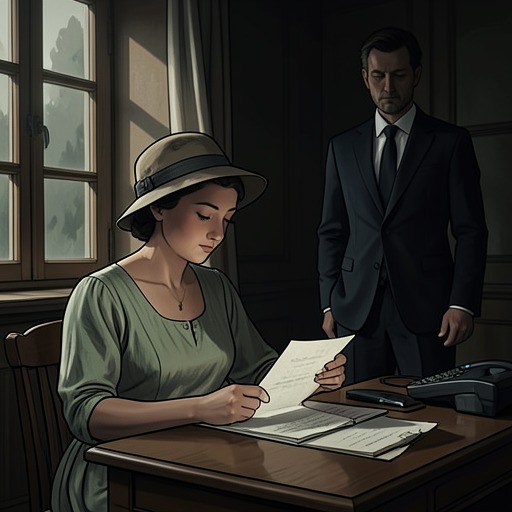
After the escape plan is discovered, Helen concludes that her duty to her son requires her to submit no longer: he must be delivered from his father’s corrupting influence. She decides not to reveal her refuge even to the woman and uncle she trusts, because their ignorance will allow them to deny all knowledge truthfully. At the same time, she creates a controlled channel for contact: communications addressed to her under cover to her brother will reach her. The arrangement balances isolation with continued connection, concealing the destination without making contact impossible.
Helen hopes her relatives will pardon her decision and trusts that, if they knew everything, they would not blame her. Yet withholding the refuge means they cannot judge the full circumstances or help openly without risking disclosure. Secrecy thus carries a cost even when it serves a protective purpose: Helen bears the uncertainty of leaving loved ones uninformed so that their ignorance can shield her and the child.
Narrative significance
The novel repeatedly makes concealed information consequential through ordinary objects and acts: a false title on a landscape, initials altered on a canvas, a portrait turned toward the wall, an unseen visitor, and a message routed through a brother. None offers the whole truth by itself. Together they show Helen managing access to her identity in stages, as each disclosure is weighed against the possibility that it could expose her whereabouts or place her child at risk.
Because the story’s first impressions are shaped by what Gilbert and the surrounding community can see, secrecy also governs interpretation. Helen’s precautions precede the reader’s knowledge of their full cause, and the resulting gap gives rumor room to flourish. Her eventual account reframes concealment not as proof of guilt but as a response to circumstances she could not safely disclose. The motif therefore links narrative suspense to women’s limited control over reputation and privacy: Helen’s silence protects her, but others use that silence to tell a story about her.